Threat Assessment and Management

Aggies Intervene, Aggies Act!

Threat Assessment and Management is a systemized and multidisciplinary approach that involves the careful identification and assessment of behaviors or situations that raise concern. These behaviors often precede violent activity that may occur at the university or to members of the university community. Early identification of these concerning behaviors and situations enables organizations to carefully and thoughtfully take appropriate precautionary steps intended to prevent targeted violence from occurring. Threat Assessment and Management also attempts to provide and/or refer supportive resources, to those who display the concerning behaviors and those that may be impacted.

At North Carolina A&T, Threat Assessment & Management categorizes, and addresses, concerning behavior across two-tiers. Each tier includes a distinct multidisciplinary team that is guided by Threat Assessment and Management staff: the Aggie Campus Assessment Response and Evaluation (CARE) Team and the Behavioral Intervention Team (BIT).
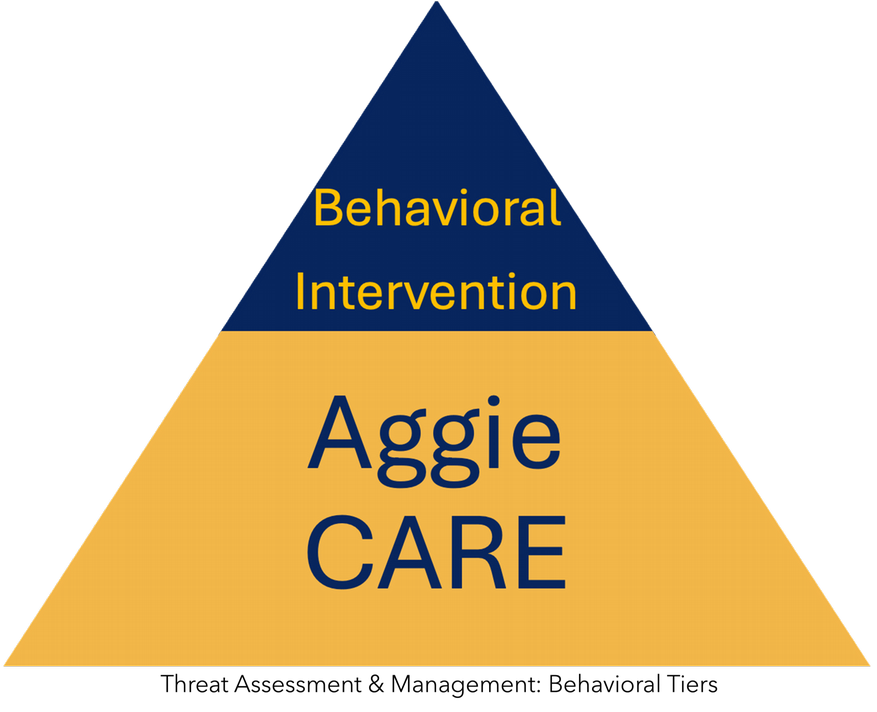
Together these teams work to proactively address concerns early on, providing tailored support and intervention. The Aggie CARE Team connects students with campus and community resources to address challenges that may negatively impact their academic success and overall well-being. This team also focuses on students whose behavior is worrisome but does not indicate a direct risk of harm. In comparison, BIT works to identify, assess, and mitigate potential threats of harm or violent activity that may impact students, employees, and non-affiliated persons. The Threat Assessment and Management staff collaborates across departments and external agencies to ensure a coordinated approach to maintaining a safe, supportive, and thriving environment for all members of the university community.


Policy Information 


Behaviors of Concern

Creating a caring campus starts with all of us. The behaviors listed below could be signs that someone is struggling or in need of help. If something gives you pause, say something. Acting early can make all the difference. For emergencies or immediate threats, call 911.

  • Missed more than 4 or more classes without contact 
  • Significant change in performance 
  • Inappropriate focus or use of violence or otherwise concerning themes present within work or research 

  • Financial stress  
  • Food insecurity  
  • Homelessness  
  • Family dysfunction/stress  
  • Concerned parent/family member  
  • Pregnancy and/or parenting needs 

  • Aggression/hostility  
  • Engaging in abusive, bullying, or intimidating behaviors towards others  
  • Retaliation  
  • Theft or damage/destruction to property  
  • Hazing  
  • Escalating dating/relationship issues (e.g. physical violence, financial abuse) 
  • Engaging in stalking or harassment of others  

 For potential violations of the Student Code of Conduct, visit the Student Handbooks. 

  • Depressed  
  • Disconnected from reality  
  • Eating disorder (anorexia or bulimia)  
  • Expression of suicidal thoughts  
  • Extreme anxiety/panic attack  
  • Extreme mood swings  
  • Extreme withdrawal  
  • Flat affect or extreme lack of responsiveness  
  • Grief and/or loss 
  • Hallucinations   
  • Overly stressed or overwhelmed  
  • Self-harming behavior (cutting, burning, etc.)  
  • Reference to having a plan to commit suicide. Stop and dial 911. 
  • Engaging in suicidal acts. Stop and dial 911. 

  • Access to weapon/brandishing weapon  
  • Alarming communications (e.g. drawings, social media posts, or other writings that cause alarm)  
  • Bizarre or erratic behavior or language  
  • Possession of unauthorized weapons  
  • Preoccupation with ammunition, bombs, fire, or weapons  
  • Preoccupation (or identifies) with violent acts or actors  
  • Attempts to harm others  
  • Threat of violence  
  • Physical assault or unwanted touching  
  • Victim of crime, bullying or harassment  
  • Witness to incident 

  • Alcohol or other drug concerns  
  • Incoherent or slurred speech 

Frequently Asked Questions

Threat Assessment and Management plays a key role in identifying and addressing concerns early. Staff are trained to assess and manage various levels of risk and they use these skills to guide both the Aggie CARE and Behavioral Intervention Teams. These teams evaluate different levels of concerning or potentially threatening behavior and determine the most effective response.  

Check out our Aggie CARE page. 

Aggie CARE and BIT are two distinct multidisciplinary teams under the Threat Assessment and Management umbrella that assess concerns and utilize case management to ensure campus safety. 

Aggie CARE 

BIT

Students Only  Employees, Students, and Non-Affiliated Individuals 

Focuses on students whose behavior is worrisome and may escalate if left unaddressed but does not indicate a direct threat of harm to North Carolina A&T.  

Also engages with students experiencing physical, emotional, situational, or psychological distress. 

Focuses on situations that may pose a potential threat of harm to themselves or others as well as the University community, property, or reputation. 

Review our Behaviors of Concern >

All reports are triaged by the Threat Assessment and Management staff to ensure the correct team is engaged. Reports may begin with one team and be referred to the other when needed. 

Everyone is responsible for the safety of our campus. Warning signs often appear before a violent tragedy occurs but often go unreported. These signs provide an opportunity to intervene and provide support before it’s too late.  

Remember: Aggies Intervene, Aggies ACT! 

Complete the Aggie Reporting Form with as much detail as possible. 

In the case of an emergency call 911 or University Police at (336) 334-7675. 

The individual of concern will not be informed of who made the referral. 

Submissions to Threat Assessment and Management are confidential. Information will only be shared with individuals or departments on a need-to-know basis to ensure appropriate support and intervention.  

A member of the Threat Assessment and Management staff may contact the initial reporter if further information is required. 

Referrals can be made anonymously, but please be thorough in your report. We encourage providing contact information to facilitate follow-up if additional details are needed.

Thank you for taking this important step to support the safety and well-being of our university!  

Each referral to Threat Assessment and Management is unique and the staff approach each case with care.  Generally, the following steps are followed upon receipt of a referral. 

  1. Threat Assessment and Management Staff review the referral and determine if it is a CARE or BIT case. 
  2. A case is created and assigned to the respective team and case manager. 
    1. Depending on the urgency and severity of the referral, other immediate steps may occur. This includes a welfare check by the University police department, direct contact to the individual(s) involved, or an immediate meeting by BIT to discuss next steps.  

Aggie CARE

Threat Assessment & Management

Supportive outreach is sent to the referred individual. This includes information on available campus and community resources, including the invitation to schedule a meeting with a case manager.  Additional information is gathered. 
The case manager provides updates to the CARE team and the team discusses next steps.  Depending on the severity of the referral, the case manager or another member of the BIT team may contact individuals connected to the referral or initiate a separate process. 
Outreach from members of the CARE Team, if appropriate.  The case manager provides updates to the BIT team and the team discusses next steps. 
Follow up outreach from the case manager to confirm connection with supportive resources, if appropriate.  Follow up outreach from the case manager to confirm connection with supportive resources, if appropriate. 
Note: Federal privacy laws, including FERPA, prohibits the sharing of specific updates to the referring party.  Note: No updates will be provided on the status of a referral unless additional information is needed or if there is a concern of imminent danger. 

WHO HANDLES? Threat Assessment & Management Student Conduct Police/Criminal
Main Question “Is there a risk of harm, and how can we reduce it?”  “Did a student break the Student Code of Conduct?” “Was the law broken?” 
Focus Safety and prevention  Campus rules and accountability  Laws and justice 
Led By Threat Assessment and Management Staff  Office of Student Conduct and Conflict Resolution  University Police Department and/or Outside Law Enforcement
Possible Outcomes Support, resources, monitoring or referral  Sanctions (warning, probation, suspension, expulsion)  Charges, arrest or prosecution 
Tone Preventive and supportive 
Disciplinary   Legal/punitive
Can These Occur Together? Yes, sometimes all three are involved  Yes  Yes 

Alvin V. Blount, Jr. Student Health Center
112 N Benbow Rd., Greensboro, NC 27411
336.334.7880 

Counseling Services
Murphy Hall, Suite 109
336.334.7727 

Office of Accessibility Resources (OARS)
Academic Classroom Building, Room 302
336.334.7765
oars@ncat.edu  


Questions? Contact Threat Assessment & Management.

Emergency: 911
University Police
: 336.334.7675
Email: ncatcares@ncat.edu

Report a Concern > 

Lauren Ghoston
Threat Assessment Manager

lghoston@ncat.edu
336.334.3706

Meet the Team >